
Surgery for peritoneal dialysis
Peritoneal dialysis passes fluid in and out of the abdomen to filter out waste products and toxins. It is an alternative to haemodialysis and has the advantage that most patients having peritoneal dialysis can have the treatment in their own home.
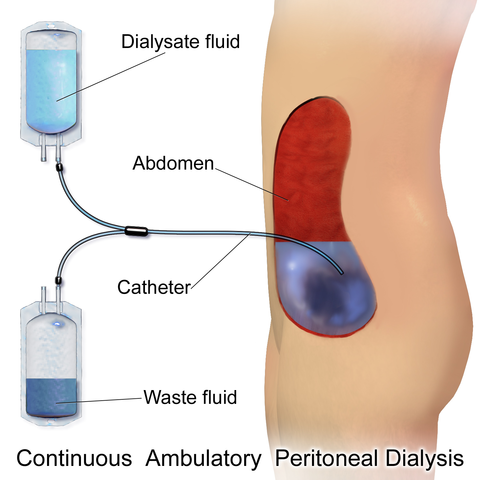
Not everyone is suitable for peritoneal dialysis. Previous abdominal surgery and certain other abdominal conditions may make peritoneal dialysis ineffective. Peritoneal dialysis is also less effective than haemodialysis at removing excess fluid from the body - so it is best for patients who still make some urine.
Tenckhoff catheter insertion
The fluid for peritoneal dialyis flows into and out of the abdomen through a plastic tube called a Tenckhoff catheter. This is inserted surgically under a general anaesthetic, and passes through a tunnel under the skin which is sealed by two cuffs around the catheter to reduce the risk of infection. The operation usually takes around 30 minutes and sometimes patients can go home later on the same day.
To work well, the tip of the catheter needs to be deep within the pelvis, but the natural movement of the bowels can move the catheter out of place. If that happens, we can usually do a laparoscopic (keyhole) operation to put it back in the right place.
Peritoneal dialysis peritonitis
Peritonitis is an infection of the abdominal cavity, and can happen if bacteria are able to get access to the abdomen through the Teckhoff catheter. Being very careful to keep the catheter end sterile when attaching and removing bags of peritoneal dialysis fluid is vitally important to reduce this risk.
If peritontis happens, it can often be treated with antibiotics given through the peritoneal dialysis catheter, sometimes with additional intravenous antibiotics. This treatment needs to be done in hospital. If treatment with antibiotics does not work, you will need an operation under general anaesthetic to remove the Tenckhoff catheter and wash out the infection from the abdomen.
Planned removal of Tenckhoff catheter
If you get a transplant or switch to haemodialysis, the Tenckhoff catheter will need to be removed to prevent future infection. We can usually do this as a minor operation under sedation by slowly pulling the catheter out. This procedure leaves the two cuffs in place; very rarely these cuffs can become infected in the future, and an operation may be needed to remove them if they become infected.
If you get a transplant from a living donor, it is very likely to work immediately, so we usually remove the Tenckhoff catheter during the transplant operation so that you do not need another procedure in the future to remove it. Transplants from deceased donors can take longer to work, so we usually leave the Tenckhoff catheter in until the transplant is definitely working, although we sometimes need to take it out if it is getting in the way of the surgical incision for the transplant.
The diagram of peritoneal dialysis is from Wikimedia Commons andy by user BruceBlausen.